
[Guest blog by Beth Riehle]
In March of 2024, at 34 years old, I heard the words no one expects to hear that young: You have stage IV tongue cancer.
I remember sitting there thinking, this can’t be right. I was healthy. I was building a life I loved. Cancer was something that happened to other people — older people — not to me.
But it was me.
After months of chemotherapy and radiation that left my body burned and exhausted, I learned the treatment hadn’t worked. My cancer was treatment resistant. I had a recurrence.
On November 26, 2024, I underwent a total glossectomy. I lost my tongue that day.
There are moments in life that split you into a “before” and “after.” This was my moment.
When I woke up from surgery, I didn’t yet understand what survivorship would require of me. I didn’t know how hard it would be to relearn something so simple as swallowing. I didn’t know the grief that would come from struggling to be understood in a noisy room. I didn’t know that something as small as not being able to lick my lips would make me feel foreign in my own body.
Survivorship, I’ve learned, is not just about living. It’s about adapting.
The first time my tracheostomy was capped and I tried to speak, I said, “I can talk.” It was barely audible, but it was mine. That fragile, imperfect sound felt like proof that maybe I hadn’t lost it all.
Speech therapy became more than exercises and repetition. It became hope. My speech team didn’t just teach me how to shape air differently; they helped me believe progress was possible even when it felt painfully slow. When I begged for a shortcut back to eating and living “normally,” I was told something simple and honest: There is no magic. Just keep trying.
So I did.
I swallowed shakes when it hurt. I stretched my jaw when it barely opened. I massaged my swelling. I practiced words that once rolled off my tongue and now felt impossible.
And quietly, in my bedroom, I started filming myself.
At first, it was just to hear what I sounded like. To measure progress. To see what others heard. But one day I decided to share a video. I didn’t know if anyone would understand me. I didn’t know if they would scroll past. I only knew that when I was first diagnosed, I searched desperately for someone like me — someone young, someone surviving, someone living beyond the surgery.
I couldn’t find her.
So I decided to become her.
Today, my platform reaches hundreds of thousands of people. Many are patients or caregivers searching for reassurance that life after head and neck cancer is possible. Some are newly diagnosed and terrified. Some are years out and still grieving parts of themselves they lost.
I share the good days — eating in public, speaking at events, returning to work. But I also share the days I cry in parking lots because a stranger says they can’t understand me. I share the anxiety. The depression. The exhaustion of constantly adapting.
Because survivorship is not linear. It is not always brave.
But it IS resilient.
There was a time during radiation when I was back to being fully tube-fed. My flap had shrunk. My mouth was full of mucus. Everything felt harder again. I worried that maybe this was as good as it would ever get.
But my team never let me believe that. They allowed space for my fear without letting it define my future.
And slowly — almost invisibly — progress happened.
Today, I can enjoy a meal with my family. I can stand in front of a room and speak with my own voice. I can advocate for others walking this path. My life does not look like it did before cancer. But it is still beautiful. It is still meaningful.
Survivorship, to me, means accepting that I will never return to who I was — and realizing I don’t have to. It means honoring the grief while choosing growth. It means understanding that strength is often quiet and built in the smallest daily decisions to try again.
There is life after cancer
And I am proud to be here to live it.
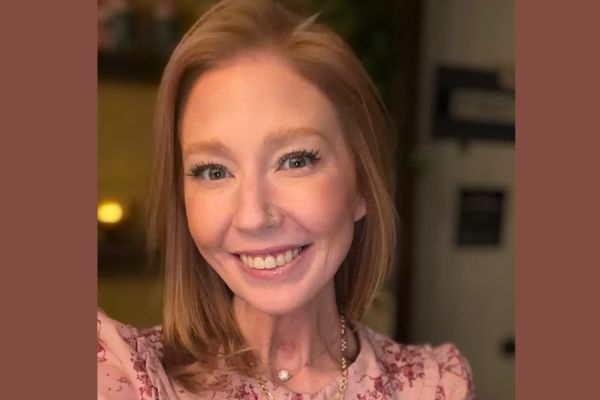
Beth Riehle is a stage IV tongue cancer survivor from Austin, TX, whose journey reshaped her voice, body, and outlook on life. After surgery and treatment, she relearned how to talk, eat, and swallow, while embracing both grief and gratitude. Through sharing her story online and on stage, Beth fosters connection through honesty and vulnerability. She speaks about the complexity of survivorship, reminding audiences that healing means holding space for both loss and joy while finding purpose in simply being here. You can find Beth here.
Beth is part of the Official NCSD Speakers Bureau Roster.
